JEE ADVANCED 2027 Official Website
Latest Update
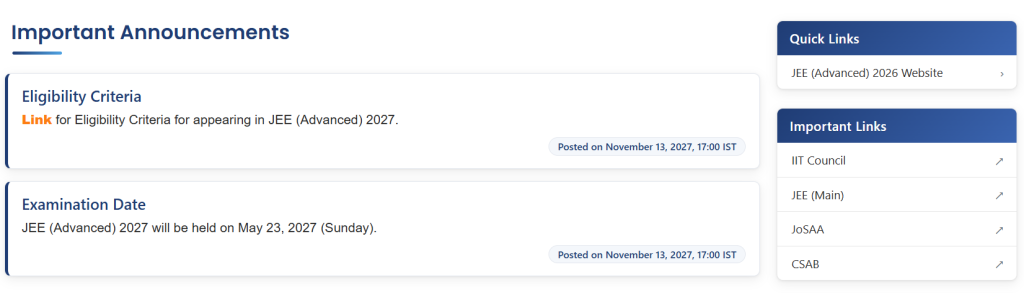
November 14, 2026: IIT Delhi has announced that JEE Advanced 2027 will be conducted on May 23, 2027. The institute has also launched the official website, where candidates can check the examination details and eligibility criteria.

According to the recently published eligibility conditions, only the top 2,50,000 successful candidates in JEE Main 2027 (B.E./B.Tech paper) will be eligible to register for JEE Advanced, subject to fulfilling the remaining eligibility requirements.
Two Attempts Only – No Third Attempt
There has been considerable demand from engineering aspirants to increase the number of attempts for JEE Advanced. Several students had appealed to the Central Government and concerned authorities to allow a third consecutive attempt after completing Class 12.
However, the authorities have retained the existing eligibility rule. Candidates will be allowed a maximum of two attempts in two consecutive years. No third attempt has been introduced for JEE Advanced 2027.
The eligibility criteria also specify that candidates must have appeared for their Class 12 or equivalent examination for the first time in 2026 or 2027, with Physics, Chemistry and Mathematics as compulsory subjects, subject to the specified exception for certain 2025 candidates.

JEE Advanced
JEE Advanced 2027 Exam Date & Eligibility: The Indian Institute of Technology (IIT) Delhi, serving as the organizing institute for the Joint Entrance Examination (Advanced), has officially launched the JEE Advanced 2027 portal at jeeadv.ac.in and announced that the national-level entrance test will be conducted on Sunday, May 23, 2027, in computer-based test (CBT) mode. Alongside confirming the JEE Advanced 2027 exam date, IIT Delhi has published the mandatory five-point eligibility criteria for Indian nationals and OCI/PIO candidates—requiring aspirants to rank among the top 2,50,000 successful candidates in JEE Main 2027 B.E./B.Tech Paper 1, be born on or after October 1, 2002 (October 1, 1997, for SC/ST/PwD), and have appeared for their Class 12 examination for the first time in 2026 or 2027 with Physics, Chemistry, and Mathematics. In a notable candidate-friendly update, IIT Delhi has also confirmed that examinees will be provided access to an on-screen basic, non-scientific calculator (10-to-12-digit display) during the examination.
Overview
| Particulars | Details |
|---|---|
| Examination Name | Joint Entrance Examination (Advanced) 2027 |
| Commonly Known As | JEE Advanced 2027 |
| Conducting Authority | IIT Delhi |
| Examination Level | National Level |
| Examination Category | Engineering Entrance Examination |
| Purpose | Admission to IITs |
| Courses Offered | B.Tech, B.S., B.Arch, Dual Degree and Integrated Programmes |
| Eligibility | JEE Main 2027 qualified candidates meeting prescribed criteria |
| Mode of Examination | Computer-Based Test |
| Subjects | Physics, Chemistry and Mathematics |
| Number of Papers | Two Compulsory Papers |
| Examination Date | May 23, 2027 |
| Application Mode | Online |
| Official Website | jeeadv.ac.in |
Important Dates
IIT Delhi has announced the examination date and published the eligibility criteria for JEE Advanced 2027. Other important dates, including registration, admit card, answer key and result announcements, will be updated on the official website.
| Events | Dates |
|---|---|
| Official Website Launch | November 13, 2026 |
| Eligibility Criteria Release | November 13, 2026 |
| JEE Advanced 2027 Registration Begins | To Be Announced |
| Last Date to Register | To Be Announced |
| Last Date for Fee Payment | To Be Announced |
| Admit Card Release | To Be Announced |
| JEE Advanced 2027 Examination | May 23, 2027 |
| Response Sheet Release | To Be Announced |
| Provisional Answer Key Release | To Be Announced |
| Answer Key Challenge Window | To Be Announced |
| Final Answer Key Release | To Be Announced |
| JEE Advanced Result 2027 | To Be Announced |
| JoSAA Counselling Begins | To Be Announced |
Eligibility Criteria
Candidates must satisfy all the eligibility conditions prescribed by IIT Delhi to appear for JEE Advanced 2027.
The eligibility criteria include JEE Main performance, age limit, number of attempts, Class 12 examination requirements and previous admission to IITs.
1. Performance in JEE Main 2027
Candidates must be among the top 2,50,000 successful candidates (including all categories) in the B.E./B.Tech paper of JEE Main 2027.
The category-wise distribution of candidates shortlisted for JEE Advanced is as follows:
| Category | Percentage |
|---|---|
| General / OPEN | 40.5% |
| GEN-EWS | 10% |
| OBC-NCL | 27% |
| SC | 15% |
| ST | 7.5% |
A 5% horizontal reservation for Persons with Disabilities (PwD) is available within each of these categories.
The total number of shortlisted candidates may slightly exceed 2,50,000 in case of tied ranks or scores.
2. Age Limit
Candidates must have been born on or after October 1, 2002, to satisfy the age eligibility requirement for JEE Advanced 2027.
A relaxation of five years is provided to candidates belonging to the SC, ST and PwD categories. Accordingly, these candidates must have been born on or after October 1, 1997.
3. Number of Attempts
Candidates can attempt JEE Advanced a maximum of two times in two consecutive years.
For example, candidates who appeared for JEE Advanced 2026 can also appear for JEE Advanced 2027, provided they fulfil all the prescribed eligibility conditions.
The authorities have not approved the demand for a third consecutive attempt.
4. Class 12 Examination Requirement
Candidates must have appeared for their Class 12 or equivalent examination for the first time in either 2026 or 2027, with Physics, Chemistry and Mathematics (PCM) as compulsory subjects.
Candidates who appeared for their Class 12 examination for the first time in 2025 or earlier are generally not eligible.
However, an exception is available for candidates whose examination board declared the results for the 2024–25 academic year on or after June 12, 2025. Such candidates who appeared for their Class 12 examination in 2025 may also be eligible, subject to fulfilling the remaining conditions.
5. Previous Admission to IITs
Candidates who have already been admitted to an IIT under an academic programme listed in the JoSAA Business Rules of 2026 are generally not eligible to appear for JEE Advanced 2027.
This condition applies irrespective of whether the candidate continued studying in the programme or subsequently discontinued it.
However, certain exceptions are available for candidates who:
- Were admitted to an IIT preparatory programme for the first time in 2026.
- Were allocated an IIT seat through JoSAA but did not report for admission.
- Withdrew their allocated seat before the last round of seat allotment.
- Had their seat cancelled before the last round of seat allotment.
Candidates must fulfil the remaining eligibility conditions to benefit from these exceptions.
Note: Foreign nationals and certain OCI/PIO candidates have separate eligibility and registration provisions. Candidates should refer to the official eligibility page for complete details.
Registration
The JEE Advanced 2027 registration process will be conducted online through the official website.
Only candidates who satisfy the prescribed eligibility criteria can complete the registration process. Indian national candidates must first qualify in JEE Main 2027 and secure a position within the prescribed shortlist.
The registration process generally involves the following steps:
Steps to Apply for JEE Advanced 2027
Step 1: Visit the Official Website
Visit the official JEE Advanced 2027 website and open the registration link once it becomes available.
Step 2: Log In
Candidates must log in using their JEE Main 2027 application credentials or other details specified by the examination authority.
Step 3: Fill in the Application Form
Enter the required personal, academic and communication details. Ensure that all the information matches the official documents.
Step 4: Upload Required Documents
Upload the necessary certificates, photographs and other documents in the prescribed format.
Step 5: Pay the Application Fee
Pay the applicable registration fee through the available online payment options.
Step 6: Submit the Application Form
Verify all the details entered in the application form and submit it.
Step 7: Download the Confirmation Page
After successful submission, download and save the registration confirmation page for future reference.
Application Fee
The category-wise application fee for JEE Advanced 2027 will be announced through the official examination brochure.
Candidates should check the applicable fee, payment methods and registration instructions before submitting their applications.
Exam Pattern
JEE Advanced is conducted as a computer-based examination consisting of two compulsory papers.
Both papers evaluate candidates’ understanding of Physics, Chemistry and Mathematics.
| Particulars | Details |
|---|---|
| Examination Mode | Computer-Based Test |
| Number of Papers | 2 |
| Paper 1 | Compulsory |
| Paper 2 | Compulsory |
| Subjects | Physics, Chemistry and Mathematics |
| Duration of Each Paper | 3 Hours |
| Total Examination Duration | 6 Hours |
| Question Types | Multiple Choice, Numerical Answer Type and other formats |
| Medium of Examination | English and Hindi |
| Marking Scheme | Varies depending on the question type |
JEE Advanced Paper 1 and Paper 2
Both papers are conducted on the same day.
- Paper 1: Generally conducted during the morning session.
- Paper 2: Generally conducted during the afternoon session.
Candidates must appear for both papers. Appearing for only one paper will not be sufficient for inclusion in the JEE Advanced rank lists.
Marking Scheme
JEE Advanced does not necessarily follow a uniform marking scheme for all questions.
Depending on the question type, the examination may include:
- Questions with one correct answer.
- Questions with one or more correct answers.
- Numerical value-based questions.
- Questions involving partial marking.
- Negative marking for incorrect responses in specified sections.
The maximum marks, number of questions, question distribution and marking scheme may vary from year to year.
On-Screen Calculator Facility
IIT Delhi has announced that candidates appearing for JEE Advanced 2027 will have access to an on-screen basic, non-scientific calculator with a 10–12 digit display.
Candidates should refer to the official examination instructions for further details about its usage.
Syllabus
The JEE Advanced syllabus covers topics from Physics, Chemistry and Mathematics, primarily based on the Class 11 and Class 12 curriculum.
Candidates should prepare all the prescribed topics and focus on developing a strong understanding of fundamental concepts.
Physics Syllabus
Important topics in Physics include:
- General Physics
- Mechanics
- Thermal Physics
- Electricity and Magnetism
- Electromagnetic Waves
- Optics
- Modern Physics
Some important chapters include:
| Topics | Important Chapters |
|---|---|
| Mechanics | Kinematics, Laws of Motion, Work, Energy and Power |
| Rotational Motion | Centre of Mass, Moment of Inertia, Rotational Dynamics |
| Gravitation | Universal Law of Gravitation, Gravitational Potential |
| Thermal Physics | Thermodynamics, Kinetic Theory of Gases |
| Electricity | Electrostatics, Current Electricity |
| Magnetism | Magnetic Effects of Current, Electromagnetic Induction |
| Optics | Ray Optics, Wave Optics |
| Modern Physics | Atoms, Nuclei, Photoelectric Effect |
Chemistry Syllabus
The Chemistry syllabus is broadly divided into three sections: Physical Chemistry, Organic Chemistry and Inorganic Chemistry.
Physical Chemistry
- General Topics
- Atomic Structure
- Chemical Bonding
- Chemical Thermodynamics
- Chemical and Ionic Equilibrium
- Electrochemistry
- Chemical Kinetics
- Solutions
Organic Chemistry
- Basic Principles of Organic Chemistry
- Hydrocarbons
- Organic Compounds Containing Halogens
- Alcohols, Phenols and Ethers
- Aldehydes and Ketones
- Carboxylic Acids and Their Derivatives
- Amines
- Biomolecules
Inorganic Chemistry
- Periodic Properties
- Chemical Bonding
- Coordination Compounds
- Metallurgy
- Qualitative Analysis
- Properties of Selected Elements and Their Compounds
Mathematics Syllabus
Important Mathematics topics include:
- Sets, Relations and Functions
- Complex Numbers
- Quadratic Equations
- Matrices and Determinants
- Permutations and Combinations
- Binomial Theorem
- Sequences and Series
- Limits, Continuity and Differentiability
- Integral Calculus
- Differential Equations
- Coordinate Geometry
- Three-Dimensional Geometry
- Vectors
- Probability
- Trigonometry
Note: The above topics provide a general overview. Candidates should refer to the official JEE Advanced 2027 syllabus for the complete list of prescribed topics.
Admit Card
The JEE Advanced 2027 admit card will be released online through the official examination website before the examination.
Registered candidates who successfully complete the application process will be able to download their admit cards using their login credentials.
The admit card generally contains the following information:
- Candidate’s Name
- JEE Advanced Registration Number
- Roll Number
- Photograph and Signature
- Examination Date
- Paper Timings
- Examination Centre Details
- Examination-Day Instructions
Steps to Download JEE Advanced Admit Card
- Visit the official JEE Advanced 2027 website.
- Click on the JEE Advanced Admit Card link.
- Enter the required login credentials.
- Submit the details.
- The admit card will appear on the screen.
- Download and take a printout of the admit card.
Candidates must carry their admit cards and valid identity proof to the examination centre.
Answer Key
The examination authority will release the provisional answer keys after the completion of JEE Advanced 2027.
Candidates will be able to compare their responses with the provisional answer key and estimate their probable scores.
The general answer key process includes:
- Release of candidate response sheets.
- Publication of provisional answer keys.
- Opening of the answer key challenge window.
- Review of submitted objections.
- Publication of final answer keys.
Candidates who identify discrepancies in the provisional answer key can submit their objections within the specified period by following the official instructions.
The final answer key will be used for evaluating candidates’ responses and preparing the results.
Result
The JEE Advanced 2027 result will be announced online through the official website.
Candidates can access their results using their registration number, date of birth and other required login details.
The result generally includes:
- Candidate’s Name
- Roll Number
- Registration Number
- Subject-wise Marks
- Total Marks
- Qualifying Status
- All India Rank, if qualified
- Category Rank, wherever applicable
Candidates who secure the minimum prescribed marks in individual subjects and aggregate marks will be included in the respective rank lists.
JEE Advanced Rank List
The examination authority prepares different rank lists based on candidates’ performance and applicable category criteria.
These may include:
- Common Rank List (CRL)
- GEN-EWS Rank List
- OBC-NCL Rank List
- SC Rank List
- ST Rank List
- PwD Rank Lists
Qualifying in JEE Advanced does not automatically guarantee admission to an IIT. Candidates must also participate in the counselling process and satisfy the admission requirements.
Cutoff
The JEE Advanced cutoff refers to the minimum marks required to qualify for inclusion in the respective rank lists.
The cutoff marks are determined based on the examination authority’s prescribed qualifying criteria.
The cutoff may vary across categories and is generally influenced by:
- Difficulty level of the examination.
- Overall performance of candidates.
- Number of candidates appearing for the examination.
- Category-wise qualifying requirements.
- Minimum subject-wise and aggregate marks.
The examination authority will announce the JEE Advanced 2027 qualifying marks along with the result.
Candidates should not confuse the qualifying cutoff with the admission cutoff. The qualifying cutoff determines eligibility for a rank list, whereas IIT admission depends on rank, seat availability, category, programme preferences and counselling rules.
JEE Advanced Counselling – JoSAA
Candidates who qualify in JEE Advanced can participate in the Joint Seat Allocation Authority (JoSAA) counselling process for admission to IITs.
JoSAA manages the centralised seat allocation process for participating engineering institutes, including IITs, NITs, IIITs and other GFTIs.
However, admission to IITs is based on JEE Advanced ranks and the applicable JoSAA admission rules.
JoSAA Counselling Process
1. Registration: Eligible candidates must register on the official JoSAA counselling portal.
2. Choice Filling: Candidates must select their preferred IITs, courses and programmes in the order of preference.
3. Choice Locking: Candidates should review and lock their choices before the specified deadline.
4. Seat Allotment: JoSAA will allocate seats based on candidates’ ranks, category, preferences and seat availability.
5. Online Reporting: Candidates who receive seats must complete the online reporting process.
6. Fee Payment: Candidates must pay the required seat acceptance fee within the prescribed deadline.
7. Document Verification: Candidates must upload the required documents for verification.
8. Final Admission: Candidates must complete the remaining admission formalities as instructed by the allotted IIT.
IIT Admission Through JEE Advanced
JEE Advanced scores are used for admission to undergraduate programmes offered by the participating IITs.
The participating institutes offer different academic programmes across engineering, science, architecture and interdisciplinary fields.
Some of the major participating IITs include:
- IIT Bombay
- IIT Delhi
- IIT Madras
- IIT Kanpur
- IIT Kharagpur
- IIT Roorkee
- IIT Guwahati
- IIT Hyderabad
- IIT (BHU) Varanasi
- IIT Indore
- IIT Gandhinagar
- IIT Ropar
- IIT Bhubaneswar
- IIT Jodhpur
- IIT Patna
- IIT Mandi
- IIT Palakkad
- IIT Tirupati
- IIT Bhilai
- IIT Goa
- IIT Jammu
- IIT Dharwad
- IIT (ISM) Dhanbad
There are currently 23 IITs participating in the admission system. The availability of courses and seats varies across institutes.
Class 12 Marks Requirement for IIT Admission
Apart from qualifying in JEE Advanced, candidates must also satisfy the Class 12 performance requirements prescribed for admission to IITs.
Generally, candidates must secure:
- At least 75% aggregate marks in their Class 12 or equivalent examination; OR
- A position within the top 20 percentile of successful candidates in their respective Class 12 board examination.
For SC, ST and PwD candidates, the minimum aggregate marks requirement is generally relaxed to 65%.
The detailed rules for calculating aggregate marks, applicable subjects and other exceptions are provided in the official admission brochure and JoSAA Business Rules.
Preparation Tips
JEE Advanced requires more than memorising formulas and solving textbook exercises. Candidates should develop conceptual clarity and the ability to apply different concepts to complex problems.
Some useful preparation strategies include:
1. Understand the Complete Syllabus
Start by reviewing the official JEE Advanced syllabus for Physics, Chemistry and Mathematics. Divide the syllabus into manageable sections and prepare a realistic study schedule.
2. Strengthen Fundamental Concepts
Focus on understanding the underlying concepts rather than simply memorising formulas. Strong fundamentals help students solve unfamiliar and application-based questions.
3. Practise Previous Years’ Question Papers
Solving previous years’ JEE Advanced papers helps candidates understand the difficulty level, question formats and examination requirements.
4. Take Mock Tests Regularly
Attempt full-length mock tests to improve time management, accuracy and problem-solving speed.
Candidates should practise both Paper 1 and Paper 2 within the prescribed examination duration.
5. Analyse Mistakes
After every mock test, identify incorrect answers, unanswered questions and topics that require additional practice.
Maintain a record of mistakes and revise those concepts regularly.
6. Revise All Three Subjects
Give sufficient importance to Physics, Chemistry and Mathematics. Avoid focusing excessively on one subject while neglecting the others.
7. Prepare for Different Question Types
JEE Advanced includes different question formats and marking schemes. Practise multiple-choice, numerical-answer and other question types to improve examination readiness.
Official Website
The official website of JEE Advanced 2027 is the primary source for all examination-related information.
Candidates can use the website to access:
- Eligibility Criteria
- Registration Details
- Application Fee
- Information Brochure
- Examination Schedule
- Syllabus
- Admit Card
- Answer Keys
- Response Sheets
- Results
- Rank Lists
- Previous Year Question Papers
Official Website: https://jeeadv.ac.in/
Candidates are advised to check the official website regularly for the latest announcements and examination instructions.
Frequently Asked Questions (FAQs)
1. What is JEE Advanced 2027?
JEE Advanced 2027 is a national-level engineering entrance examination conducted for admission to undergraduate programmes offered by the Indian Institutes of Technology (IITs).
2. Who is conducting JEE Advanced 2027?
IIT Delhi is the organising institute for JEE Advanced 2027.
3. When will JEE Advanced 2027 be conducted?
JEE Advanced 2027 will be conducted on May 23, 2027 (Sunday).
4. Who is eligible to apply for JEE Advanced 2027?
Candidates must be among the top 2,50,000 successful candidates in the B.E./B.Tech paper of JEE Main 2027 and fulfil the other prescribed eligibility conditions.
5. How many attempts are allowed for JEE Advanced 2027?
Candidates can attempt JEE Advanced a maximum of two times in two consecutive years.
6. Has the third attempt been introduced for JEE Advanced 2027?
No. Despite requests from students for a third attempt, the authorities have retained the existing two-attempt eligibility rule.
7. What subjects are included in JEE Advanced 2027?
The examination includes Physics, Chemistry and Mathematics.
8. Is it compulsory to appear for both JEE Advanced papers?
Yes. Both Paper 1 and Paper 2 are compulsory. Candidates must appear for both papers to be considered for the rank lists.
9. What is the examination mode of JEE Advanced 2027?
JEE Advanced 2027 will be conducted in Computer-Based Test (CBT) mode.
10. How many IITs participate in JEE Advanced counselling?
There are 23 IITs participating in the admission system. Seats are allocated through the centralised JoSAA counselling process.
11. Can candidates get admission to IITs through JEE Main?
No. Admission to undergraduate programmes at IITs is based on JEE Advanced performance, subject to the prescribed eligibility and counselling requirements.
12. Is qualifying in JEE Advanced sufficient for IIT admission?
No. Candidates must qualify in the examination, satisfy the Class 12 admission requirements and obtain a seat through the JoSAA counselling process.
13. Where can candidates check JEE Advanced 2027 updates?
Candidates can visit the official website, jeeadv.ac.in, for registration details, examination notifications, admit cards, answer keys and results.